
Nobody Else Has Your Swedish
On roots, identity, and why the thing that makes you unrepeatable is the thing that makes you powerful

It was an ordinary Thursday evening.
I had a documentary on in the background — something about ABBA — while I worked through the growing pile of papers on my office floor that had been silently judging me for weeks. I like documentaries about music groups. There’s something fascinating about learning how people got started, what drove them, and why they made the choices they made.
I wasn’t really watching. I was listening while sorting.
And then Bjorn from ABBA said this:
“One thing we’d learned is that everything starts with a song. I think great music is created from the human experience. Deep emotions. Writing a lyric is something in between a poem and a melody. It would conjure up not only a mood, but images. Almost cinematic.”
I stopped sorting.
Then Nile Rodgers of Chic — signed to the same label at the same time — added something that made me back the documentary up and transcribe both word for word:
You have to understand that people have different roots. They’re Swedish. They’re not from California or New Orleans or wherever. They have a culture that is uniquely theirs.
I abandoned the sort piles entirely. Sat down. And started writing.
Because neither of them was just talking about music.
They were talking about everything that makes any of us — our art, our work, our businesses, our lives — impossible to replicate.
They were talking about roots.
And I couldn’t stop thinking about mine.
When Nile Rodgers says ABBA is Swedish — he’s not talking about geography.
He’s talking about the specific cocktail of experience, culture, family, memory, and place that shaped the way they heard music before they ever wrote a single note. The particular light of a Scandinavian winter. The folk melodies their grandmothers hummed. The way emotion gets expressed — or doesn’t — in that part of the world. All of it, woven together into something that couldn’t have come from anywhere else.
That’s not an accident. That’s not a strategy.
That’s roots.
And here’s what I believe with everything I have: every single one of us has a version of Swedish. A specific cocktail that is entirely, unrepeatably, wonderfully ours. The place we grew up. The parents who shaped us. The things we were handed — and the things we had to figure out on our own. The moments that cracked us open and the ones that quietly held us together.
Most of us just don’t think of it that way.
We think of our background as context. As the thing that happened before the real story started.
But what if it IS the story? What if everything you’ve built — your work, your art, your relationships, the life you’re living right now — grew directly from those roots, whether you knew it or not?
I started thinking about mine. And Jerry’s. And what happens when two very different kinds of roots grow toward each other?
I was born in rural Ohio.
By the time I was in eighth grade, I had also lived in Mississippi, North Carolina, Germany, Colorado, and Idaho before landing in Maryland — where I would eventually finish school, meet Jerry, and build a life.
Most people hear that and say that must have been so hard. And maybe it was, in ways I couldn’t name yet. But what I remember most isn’t the hard parts. What I remember is what all that movement gave me.
It gave me eyes.
Not just the ability to see — but the instinct to read. To notice things. Every new place was a new language, and I learned to speak it before I learned anyone’s name. The way people dressed. The way they held themselves. What was loud and what was quiet? What was present and what was conspicuously absent.
In Germany, we lived in a third-floor walk-up in a small town off base — one real window in the whole apartment, facing the living room. The kitchen, bathroom, and my parents’ room all had narrow windows that popped up from the ceiling. My brother used to stand on the kitchen counter and toss wooden spoons out the window. We became friends with the family downstairs. Catherine, I think it was her name. Quiet apartment. Reserved in the way our family — four kids, full of laughter and noise — simply was not. Different clothes. Different money. Different world.
But to me, she was just another girl to play with.
That’s what moving teaches you if you let it. Not that people are different. That different is just people.
We drove past a swimming spot on the way to church, and Mom noticed the women were topless. We kids giggled. But underneath the giggle was something else taking root — oh. People do things differently here. And the world doesn’t end.
And then there was Prague.
We visited it not long after it emerged from communism. I remember the whole city was gray. Not a mood — a color. The buildings. The streets. And the cars — I remember seeing cars that were literally two different vehicles welded together. The front of one, the back of another. A Toyota married to a Volvo by necessity. A whole city making do with whatever pieces it had left after decades of being told what it could and couldn’t be.
I was a child, and I couldn’t have articulated any of that then. But I felt it. Filed it away in the place where you store things your body understands before your mind catches up.
My dad had a way of pulling those things back out. His favorite question — asked about everything, big and small, ordinary and extraordinary — was why do you suppose. Not as a test. As an invitation. He genuinely wanted to know what you thought. He wanted you to look at the world and wonder about it.
My mom had a quiet resolve that made us kids absolutely certain she could do anything. Whatever the problem was, she would solve it. That was simply not in question.
Between the two of them, they handed me something I’ve carried my entire life: the wonder of paying attention, and the confidence to do something with what you notice.
That’s my Swedish.
A girl who grew up reading the world like a book — noticing the gray cities and the quiet apartments and the welded cars and the wooden spoons flying out a ceiling window — and filing it all away into a lens she didn’t even know she was building yet.
Jerry’s story couldn’t be more different from mine.
He was born in Baltimore and raised in Pasadena, a blue-collar neighborhood tucked along the water in the greater Baltimore area. And when I say along the water, I mean along the water. Less than two blocks from his front door, he could put a john boat in and spend the day fishing or crabbing. Which he did. Whenever he could.
Where I grew up reading the world by moving through it… Jerry grew up reading the world by going deep into it.
Same neighborhood. Same water. Same people. He started kindergarten and graduated from high school with the same friends. Everyone knew everyone. You knew your neighbors not just by name but by story — their kids, their struggles, their backyard, their boat. That’s the kind of place that either suffocates you or roots you so deep that nothing can knock you over.
For Jerry, it was roots.
His dad was an engineer at a mattress manufacturer — a man who held several patents for his designs. And it wasn’t just his dad. Jerry’s grandfather held a patent too … on a toothpaste holder of all things. Think about that for a second. Two generations of men in a blue-collar neighborhood quietly putting their names on things they invented. That’s not nothing. That’s a boy growing up watching the men around him create something that outlasted the workday.
And then there were the cars. Muscle cars — in the neighborhood, with his friends, on the streets of Pasadena, through junior high and high school. The kind of cars that had a voice you felt in your chest before you saw them coming. Jerry grew up fluent in that language. He still is.
His dad worked hard. He also had a gift with prose and a seemingly endless supply of dad jokes that he told with absolute commitment to his dying day. Jerry inherited every bit of that too — the humor, the warmth, the ability to walk into any room and make people feel immediately at ease. It’s why a two-year-old in Peru toddled straight toward him. It’s why an alpaca chose him as a running companion on a mountain road at 14,000 feet.
Some gifts skip nothing. They just pass straight through.
Jerry did join the Air Force out of high school — spent time in Spain, briefly in Oklahoma. But he came back. Back to the same area. Back to the water. Eventually, back to the very house he grew up in, which he and I bought from his parents, who had bought it from his grandparents.
Some people need to move through the world to understand it.
Jerry needed to go two blocks to the water and be completely still in it.
That stillness — that capacity for deep presence — is something I noticed about him long before I had words for it. He is the man who waited at the Sun Gate at the top of the Inca Trail so we could see Machu Picchu together for the first time. The man who got down on one knee in the dirt in a Peruvian village to have a full conversation with a two-year-old named Daniel in broken Spanish and belly laughs. The man who was in the middle of the Sacred Valley at Chinchero walked to the edge of an ancient Inca terrace and stood there with his mouth opening and closing — unable to speak, completely undone by something too vast and too beautiful to put into words.
He didn’t need to have traveled the world as a child to be cracked open by it.
He just needed to be present enough to let it in.
And he always has been.
So here we are.
A girl who grew up reading the world by moving through it — wide lens, always noticing, filing away the gray cities and the quiet apartments and the welded cars — and a boy who grew up going two blocks to the water and being completely still in it. Deep lens. Deep roots. Deep presence.
Different beginnings. Different foundations. Different Swedish.
And yet when those two lenses found each other something remarkable happened. Not because we were the same. Because we weren’t.
That’s the thing about roots. They don’t have to match to matter. They just have to be genuinely, unapologetically yours.
Which makes me wonder about yours.
What did your specific childhood hand you that you’ve been carrying without realizing it? What did your neighborhood teach you? Your parents? The thing you had plenty of — or the thing you didn’t have at all?
Because I promise you — it’s in there. Shaping everything. Whether you know it or not.
Here’s where I want to push back on something.
Because if you’ve read this far, you might be thinking … okay, but I’ve lost touch with my roots. I don’t even know what my Swedish is anymore. Life happened, and somewhere along the way I stopped being that person.
I understand why it feels that way. I really do.
But I don’t think you lost yourself.
I think you changed seasons.
I was a curious, wonder-filled kid reading the world through a wide lens. And then I was a young woman in her early twenties living alone for the first time, working two jobs to pay the bills, growing up fast because there was nobody else to do it for me. And then I was supporting the man I loved through an awful divorce and the disappearance and murder of his sister. And then I was a wife and a stepmom to a six-year-old. And then I was a mom with my whole heart — two daughters who were quite literally my everything, and I gave them all of it without reservation.
And here’s what I want you to hear:
I totally enjoyed every single version of me that I was at the time I was that person.
Every single one was real. Every single one was valid. Every single one was ME — just me in a different season, doing what that season asked of me.
The roots didn’t disappear. They just went underground while I did the necessary work of living.
And then my youngest graduated from high school and left for college. Within the same month, I lost my dad to cancer. Then Jerry got Covid and almost died. And I found myself standing in the rubble of the busiest, fullest season of my life wondering — who am I going to be now?
I could have contracted. A lot of people do.
Instead, I trained for Peru.
Not because I was brave. Because my roots were still there holding me. The girl who read Prague. The kid who thought Catherine downstairs was just another girl to play with. The daughter of a man who asked why do you suppose until he couldn’t ask it anymore. She never left. She was just underneath — waiting for the moment she could finally be the whole story.
The proof came in an unexpected place. While working through assignments from our transformation coach — digging deep, excavating the layers — I came across a photo of myself around four or five years old. Bandana on my head. Eyes full of something I could only describe as innocent wonder.
And I realized: I wasn’t becoming someone new.
I was going back to someone old.
Your roots held you too. Through every season. Through every version of yourself you’ve had to be. They’re still there.
You just have to dig.
And here’s what happens when you do.
When you stop performing a version of yourself built for other people’s comfort and start moving from your actual roots — something shifts. You become harder to rattle. The things that used to make you second-guess yourself lose their grip because you’re no longer defending a performance. You’re just being true. And truth doesn’t need defending.
You also become harder to replace. Not because you’re better than anyone else — but because you’re completely, specifically, unrepeatable you. Nobody can out-you you. They can copy your strategy, your style, your tools. They cannot copy your Swedish.
And perhaps most surprisingly … you become magnetic. People are drawn to real in a way they are never drawn to polished. They can feel the difference even when they can’t name it. Authentic doesn’t just feel better. It works better.
That’s the power your roots give you.
Not power over anyone else. Power to finally, fully, show up as yourself — in your work, your relationships, your creative life — without apology and without exhaustion.
Because performing is exhausting.
Being is not.
So now I want to ask you something.
Not about me. Not about Jerry. Not about ABBA or Nile Rodgers or a documentary that stopped me mid-filing on an ordinary evening.
About you.
What are your roots?
Not your resume. Not your job title or your business plan or the version of yourself you present on a Tuesday morning when you need to seem like you have it all together.
Your actual roots.
Where did you come from? What did that place — that family, that neighborhood, that particular cocktail of abundance and lack — hand you that you’ve been carrying ever since? What did you learn to notice? What did you learn to survive? What did someone put in your hands, or in your chest, that you’ve never been able to put down?
Maybe you grew up moving like I did — wide lens, always the new kid, learning to read every room before you learned anyone’s name. Maybe you grew up rooted like Jerry — deep knowing, same water, same people, the kind of place that holds you so completely you carry it with you everywhere you go.
Maybe your roots look nothing like either of ours.
But they’re there. Shaping the way you see. Shaping the way you work and love and create and show up. Shaping the thing you do that nobody else can quite replicate — even if they use the same tools, the same words, the same strategy.
Nobody else has your Swedish.
And the world — I promise you this — needs exactly what your roots grew.
Not a polished version of it. Not a sanitized, made-for-public-consumption version of it. The real thing. The full thing. The you that was already there before you knew you were building anything at all.
That version of you is not lost.
She’s just waiting to be the whole story.
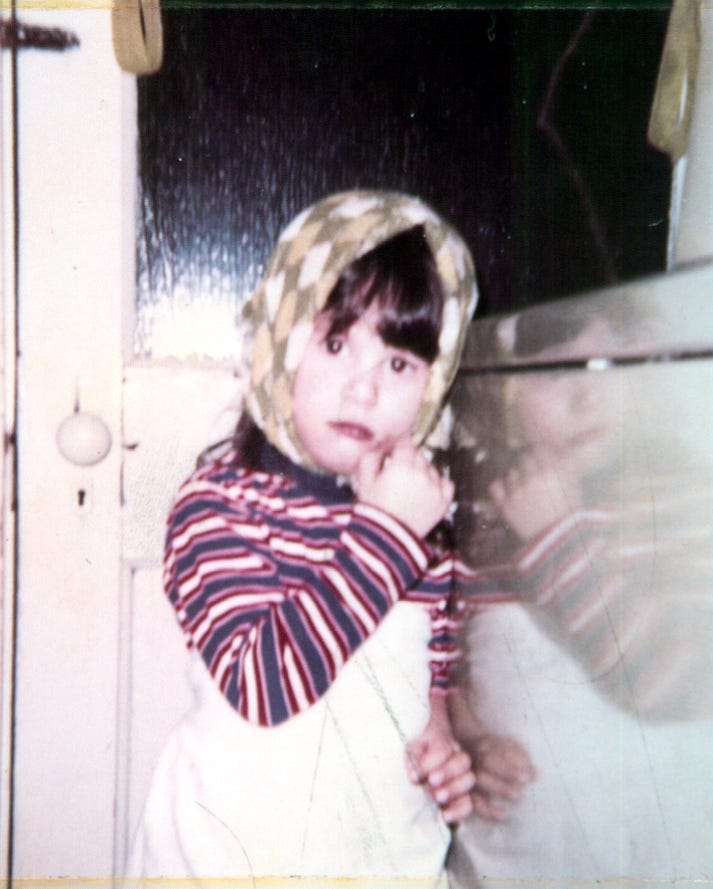
I keep a photo on my desk.
It’s not framed. It’s not particularly well composed. It’s just a small girl — three years old — with a bandana on her head and something in her eyes that I can only describe as wonder. Pure, unguarded, not-yet-complicated wonder.
That’s me.
I found it while doing the deep excavation work that eventually led me to Peru, to this Substack, to the memoir I’m writing, to the life Jerry and I are building on purpose. I wasn’t looking for anything in particular when I found it. I was just digging.
And when I saw it, I understood something I hadn’t been able to articulate before.
I wasn't becoming someone new. I was returning to someone who had been there the whole time. Finally becoming who I always already was.
The girl in that photo already had her roots. Already had the wide lens and the wonder and the instinct to read the world with curiosity instead of fear. She just had a lot of living to do first — a lot of seasons to move through, a lot of people to love and hold and show up for — before she could finally turn that lens on herself and say: there you are.
Bjorn from ABBA said that everything starts with the human experience. Deep emotions. Almost cinematic.
He was right. And it doesn’t matter whether you make music or photographs or a marketing strategy or soup from water and your mother’s entire jar of parsley on the front porch. It all starts the same way.
With who you actually are.
With where you actually came from.
With the specific, unrepeatable, wonderfully yours cocktail of experience and memory and love and loss that made you see the world the way only you can see it.
That’s not context. That’s not backstory.
That’s your Swedish.
And it was always, already, enough.
Until next time…
still dreaming, still climbing, still becoming…
…still going back to the girl in the bandana
~Lori